
In a wholesale, distribution, or B2B e-commerce business, stock counts are a core management tool. They’re not just about counting products. They provide a clear, reliable view of what the business actually owns, so purchasing, sales, and financial management stay aligned.
Without a structured inventory count, decisions are based on approximations. With a well-organized process, you secure logistics operations, prevent stock discrepancies, and improve overall profitability.
Stocktaking serve a dual purpose.
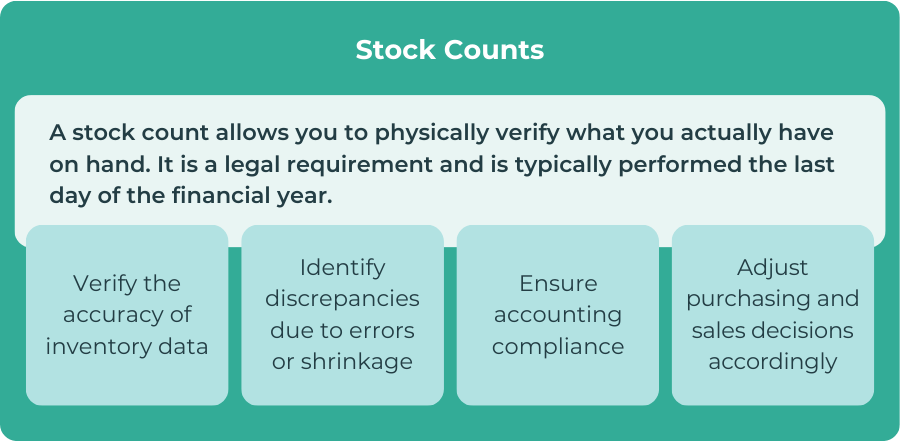
On one hand, they are a legal requirement. In most cases, they must be performed at least once a year, typically the last day of the financial year.
On the other hand, they are a powerful management lever, allowing you to verify actual on-hand quantities and ensure the accuracy of the data used every day.
This process plays several key roles:
A reliable stock count directly improves customer service. When a company knows its exact inventory levels, it reduces stockouts, avoids overstocking, and responds faster to demand.
Stock counting should not be seen as a one-time burden, but as a structured management process.
Regular monitoring prevents the accumulation of errors, optimizes product turnover, reduces tied-up capital, and keeps inventory levels aligned with real business activity. When data is reliable, sales teams sell with confidence, purchasing is better anticipated, and operations run more smoothly.
An effective stock count starts with preparation and method. High-performing companies structure their process in advance to limit errors and speed up counting:
This organization reduces mistakes, speeds up the process, and strengthens long-term data reliability.
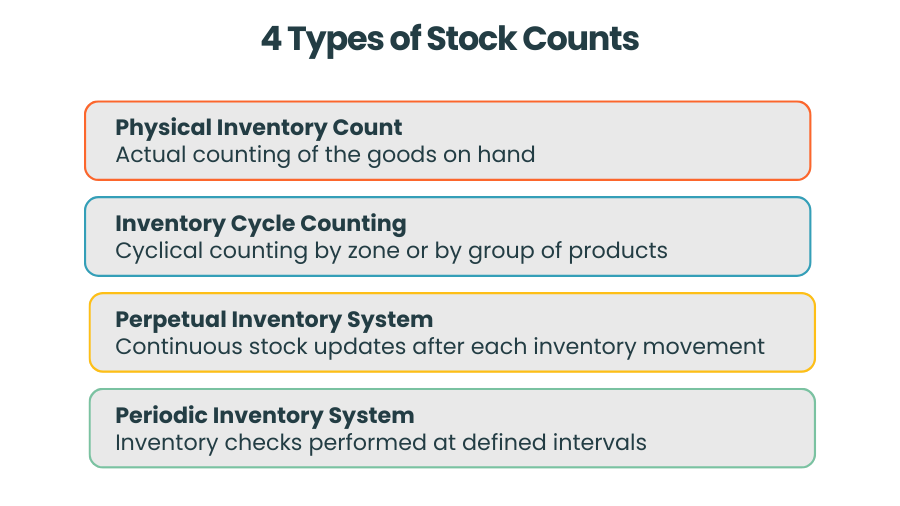
Not all companies structure their stock counts the same way. The choice depends on activity volume, operational complexity, and the level of accuracy required.
Regardless of the method, it’s recommended to involve multiple team members during a slower business period and to use barcode scanners to increase efficiency.
A physical inventory count involves an actual count of all goods on hand. It remains the benchmark method for validating stock accuracy.
It generally requires partially or fully pausing inventory movements, counting items one by one, and reconciling results with system data. While highly reliable, it is time-consuming and can temporarily slow down operations.
Cycle counting spreads inventory checks throughout the year instead of reviewing everything at once.
Each period focuses on a specific zone, product category, or group of SKUs. This ensures continuous stock accuracy without stopping operations and distributes the workload over time. Today, it is a standard best practice in structured logistics organizations.
Perpetual counting relies on continuously updating inventory after every incoming or outgoing movement. Quantities are adjusted automatically in your inventory management system, without waiting for a full physical count.
This approach provides real-time visibility, simplifies discrepancy detection, and secures purchasing and sales decisions while reducing the need for heavy annual counts. It complements physical verification to maintain reliable monitoring year-round.
A periodic inventory count verifies stock at defined intervals (monthly, quarterly, or annually). Adjustments are made only at the time of counting.
This method is simple to implement but offers less precise visibility between counting periods.
Many businesses still manage inventory using multiple spreadsheets or manual data entry. This approach quickly reaches its limits as operations grow.
Common challenges include:
When data is not centralized, stock counting becomes heavy and disconnected from real operational management.
By using inventory management software like Erplain, companies turn stocktaking into a continuous process integrated into daily operations. Updates occur automatically after each movement, inbound and outbound flows are tracked, and information is shared across teams. The business operates on a reliable, centralized data foundation without redundant data entry.
Stock counting is no longer an isolated event, but an ongoing management tool.
Erplain includes features designed to make inventory management and stock counts faster, more reliable, and better suited to the operational constraints of small and mid-sized businesses.
Track incoming and outgoing goods continuously across all your storage locations. Stock levels update automatically after each purchase order, sales order, or adjustment.
You can instantly view available quantities by location. Orders remain synchronized with stock levels, and low-stock alerts help prevent shortages. You always have reliable data without manual re-entry.
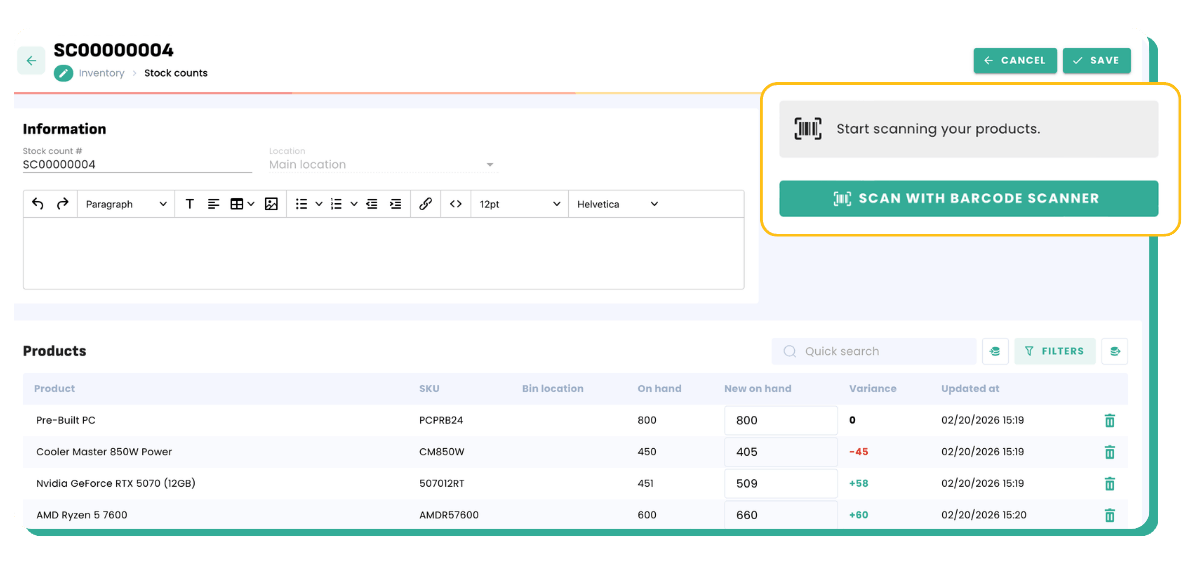
Depending on your organization, you can:
This flexibility allows you to adapt your stock count process to your operational reality.
When a stock count is launched, Erplain records a reference stock snapshot. Adjustments are automatically compared against this baseline, immediately highlighting discrepancies between theoretical and actual stock. Commercial activity can continue in parallel.
Multiple team members can work simultaneously on the same stock count.
Each person handles a specific zone or group of SKUs, while information synchronizes in real time. This structure accelerates the overall process.
Stock counting becomes a controlled, integrated process within your commercial operations rather than an exceptional task.
Stock counts remain essential for any business handling physical goods. When properly organized, they secure data accuracy, optimize logistics flows, and improve profitability management.
However, traditional methods show clear limits in today’s environment, where responsiveness and reliability are critical. Digitizing this process increases precision, efficiency, and visibility.
With a solution like Erplain, stock counts naturally integrate into daily operations. Businesses gain reliable, shared, and immediately actionable information to support performance growth.
A stock count involves physically counting the products on hand and comparing those quantities with the figures recorded in your management system. Discrepancies are then analyzed and corrected to ensure accurate data.
The main types are physical inventory counts (annual inventory counts), cycle counting (distributed throughout the year by zone or SKU), and perpetual inventory counting (continuous real-time updates after each stock movement).
Preparation requires clearly organized storage areas, proper product identification, a standardized counting method, and scheduled time slots that minimize operational disruption.
A stock count generally follows five stages:






.png)