.png)
If you are about to create or buy a business, you have certainly heard about the concept of a break-even point. In a way, it is the compass for the entrepreneur. Concretely, it allows you to know what amount of turnover you need to reach in order to start generating a profit. It is therefore fundamental for the growth and sustainability of any business! But how do you calculate it? That's what we're going to see together.
What you will learn in this article:
Before explaining how to calculate the break-even point, it's important to remember what the break-even point is for.
Every business has a certain number of expenses each month. The break-even point corresponds to the minimum turnover that it must achieve over a given period of time to cover all these expenses. This is the balance point where all of the company's expenses are exactly the same as the total revenue.
In other words, When a business reaches the break-even point, it generates no loss or profit. Below this threshold, it is in deficit; above that, it makes a profit (which is good news).
As you will have understood, it is therefore one of the indicators to watch closely, especially when you are creating your business, and especially if you are looking for financing! The break-even point is found in certain documents, such as the business plan or the provisional financing plan.
It is also essential throughout the development and management of the company. It gives you a goal to reach over a specific period of time. You can base your sales strategy on this threshold after calculating it, and thus set realistic sales goals.
Thanks to its calculation, all the decisions you make are informed and allow your business to grow, while ensuring financial stability.

Now that you understand its importance, let's see how to calculate it correctly.
To calculate the break-even point in valu, the formula is as follows:
Profitability threshold = Annual fixed expenses/Variable margin rate on costs
This calculation is done between 3 steps:
Let's discover in detail all these indicators that are essential for calculating the break-even point.
Fixed expenses correspond to all the expenses that the company will have to cover no matter what happens. For example:
Variable expenses, on the other hand, are those that change according to your turnover and your level of activity. Concretely, the more you make numbers, the more your expenses increase and vice versa.
The challenge here is to know how to measure and anticipate them as accurately as possible in order to calculate the break-even point. For example, these are:
If you are starting a business, you do not know your turnover. In your business plan, you should determine a minimum achievable turnover based on your predictions and your services/products.
The variable cost margin determines your ability to cover your fixed expenses and generate profit. It is nothing more, nothing less, an indicator of profitability.
To calculate it, here is the formula:
Turnover — Variable expenses
This rate makes it possible to define the percentage of gain or loss for each sale and service carried out. To calculate it, use this formula:
Margin rate on variable costs = (Turnover - Variable costs)/Turnover

Let's say you have a construction company with a turnover of €500,000. Your fixed expenses amount to €60,000 and your variable expenses to €90,000.
So you need to do the following calculations:
The break-even point is reached starting at €73,170.73 of turnover.
Round up your fixed expenses to the next number to anticipate a possible increase in costs over time. Once you have calculated and the breakeven point, consider adding a safety margin of 5 to 10% to cover risks and unforeseen events.
One thing is certain: you cannot do without adjusting your break-even point as your business evolves. Especially in case of increased expenses (moving to larger offices, recruitment, investment in new equipment...)!
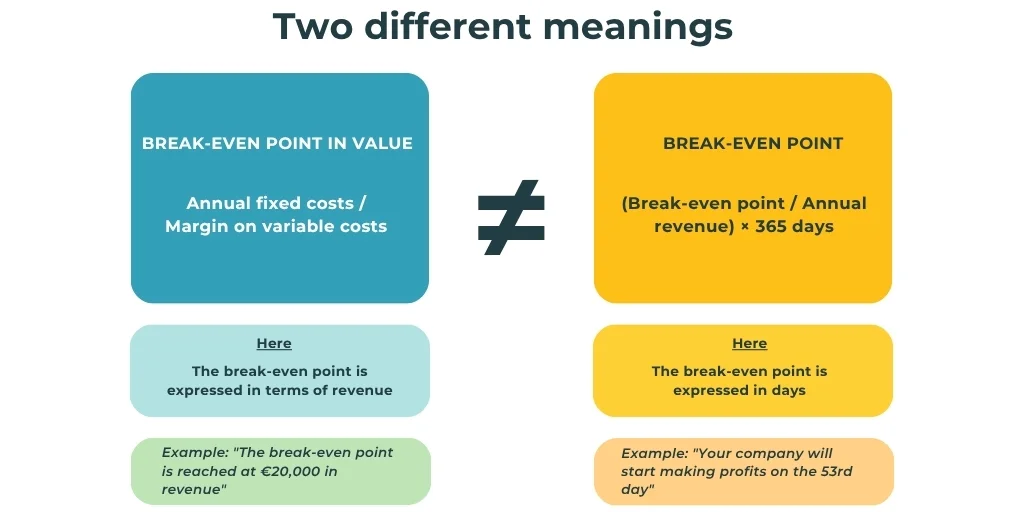
The break-even point is closely related to the break-even point in value, but the two concepts are different and should not be confused. It should therefore be used, but not confused! Simply put, calculating the break-even point tells you how long it will take your business to reach its break-even point.
The break-even point is expressed as a number of days and can be calculated using the following formula:
Break-even point = (Breakeven Threshold/Annual revenue) × 365 days
Let's calculate the breakeven point for our previous example: (73,170.73/ 500,000) × 365 days.
Your business will start making a profit after the 53rd day.
If an activity in your business is not generating enough profits, consider suspending it to focus on more profitable segments. This decision becomes relevant when efforts such as the rationalization of expenditure and the restructuring of the activity concerned have not produced the expected results.
To improve overall profitability, you have several levers of action : act on the margin rate, on variable costs or on fixed expenses. Here are some examples of effective strategies :
These measures require a thorough assessment of the cost structure and an understanding of market dynamics to effectively optimize revenue.

With its advanced inventory management features, Erplain can help you optimize your inventories and manage your TPE in real time.
The break-even point is the minimum amount of revenue a business must generate to cover all its fixed and variable expenses. At this point, the business is neither making a profit nor operating at a loss. Once revenue exceeds the break-even point, the business begins to generate a profit.
The formula is:
Break-even point = Fixed expenses / Variable cost margin rate
The variable cost margin rate is calculated as follows:
(Revenue – Variable costs) / Revenue
The break-even point represents the amount of revenue a business must generate to become profitable. The break-even date indicates when, or after how many days, the business is expected to reach that amount.
The formula is:
Break-even date = (Break-even point / Annual revenue) × 365
The calculation should include fixed expenses, such as rent, salaries, insurance, and subscriptions, as well as variable costs that change with the level of business activity, such as merchandise, raw materials, shipping, and sales commissions.
Because a new business does not yet have actual revenue figures, the calculation must be based on the financial projections in its business plan. Fixed expenses, variable costs, and projected revenue should be estimated using expected sales prices, sales volumes, and market conditions.
It is advisable to recalculate it at least once a year and whenever the business experiences a significant change. This may include hiring new employees, rising supplier prices, moving to new premises, investing in equipment, or changing sales prices.
A business can lower its break-even point by reducing fixed expenses, controlling variable costs, or improving its margins. This may involve renegotiating purchasing costs, reducing unsold inventory, streamlining operations, or adjusting sales prices.
A high break-even point means that the business must generate a significant amount of revenue before it begins to make a profit. This can make it more vulnerable to changes in sales. However, the figure should always be assessed in relation to the company’s industry, business model, and margins.
Inventory ties up cash and generates costs related to storage, handling, and depreciation. Better control over purchasing, inventory levels, and unsold products can help reduce variable costs and improve the company’s overall profitability.