
Ordering 500 units so you have enough inventory for the next six months may feel reassuring. But during those six months, those products take up warehouse space, tie up cash, and may not sell as well as expected.
Just-in-Time (JIT) takes a different approach. JIT is a flow management approach designed to produce or replenish only what is needed, when it is needed. In logistics, this approach is closely associated with tight flow, where goods move through the supply chain with minimal inventory and are received as close as possible to the time they are needed for production, sale, or shipment.
This helps businesses reduce excess inventory and the costs associated with holding it.
The concept sounds simple. In practice, however, operating with less inventory also leaves less room for error when demand suddenly increases or a supplier is late.
How does JIT inventory management work? What types of businesses can benefit from a tight flow strategy? And how can you reduce inventory without increasing the risk of stockouts?
Just-in-Time (JIT) is a flow management approach that aligns purchasing, production, and replenishment as closely as possible with actual demand. Instead of building up several weeks or months of inventory in advance, goods are ordered or produced when they are needed.
For a B2B distribution company, for example, this might mean ordering smaller quantities from suppliers more frequently instead of filling a warehouse in anticipation of several months of future sales.
The same principle applies to manufacturing. Components and raw materials arrive shortly before they are needed, limiting the amount of time they remain tied up in inventory.
The goal is not necessarily to maintain zero inventory. A company may still keep minimum stock levels or safety stock for certain sensitive products. The main objective is to shorten the time between purchasing a product and using or selling it.
Just-in-Time and tight flow are closely related concepts, but the terms do not describe exactly the same thing.
JIT is the broader flow management approach. It aims to synchronize supply, production, and distribution with actual needs while keeping unnecessary inventory to a minimum.
In logistics, tight flow describes the operational organization of those flows. Goods are received close to the time when they are needed for production or scheduled to be shipped, which limits intermediate storage.
JIT was notably developed through the Toyota Production System and has historically been closely associated with manufacturing. Today, the same principles are also applied to procurement, distribution, and inventory management.
In practice, a company following a JIT strategy will often use tight flow logistics to put those principles into operation.
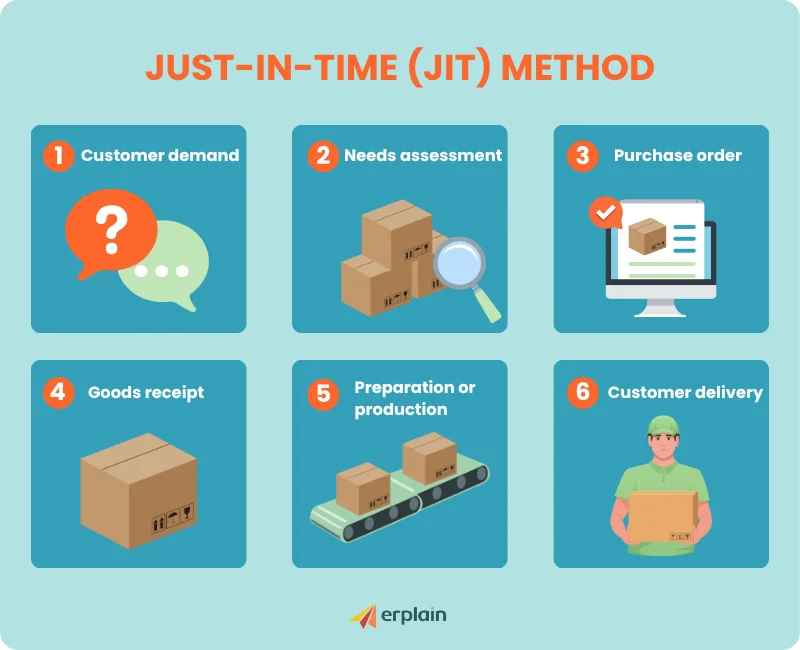
Consider an SMB that distributes professional equipment to resellers.
One of its best-selling products sells about 200 units per month. Until now, the company ordered 600 units every three months. As a result, part of its cash remained tied up in inventory, with boxes sometimes sitting in the warehouse for several weeks.
With JIT inventory management, the company changes its purchasing rhythm. Instead of placing one large order, it orders 100 or 150 units more frequently based on actual sales.
Inventory levels decrease, a new purchase order is triggered, the products are received and quickly sold, and the cycle starts again.
This system works as long as all the moving parts remain synchronized. Inventory levels need to be accurate. Supplier lead times need to be known. Sales must be monitored regularly, and purchase orders must be placed early enough.
A delay of just a few days can quickly change the situation.
Imagine that the supplier usually delivers within four days. On Monday morning, the company receives an unusually large order for 80 units from one of its customers. It expects to replenish inventory as planned, but on Wednesday, the supplierannounces a three-day delay.
With 300 units of safety stock in the warehouse, the delay would barely be noticeable. With only 40 units available, every day matters. A delay can weaken the business relationship and may even result in losing the customer.
These concepts are closely related and are often confused, but they describe different ways of managing supply and inventory.
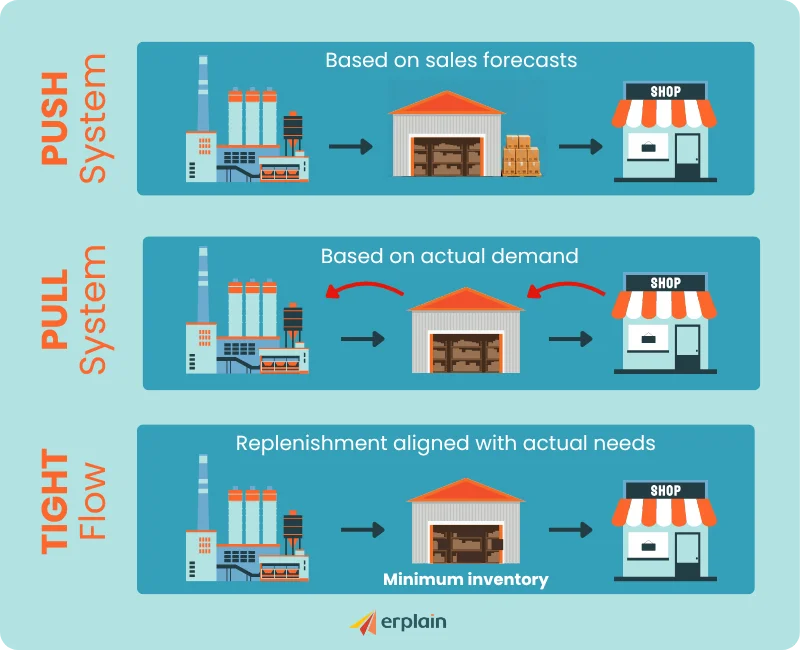
In a push system, a company purchases or produces goods based on forecasts.
If it expects to sell 3,000 units over the next three months, it may manufacture or order those 3,000 units before receiving the corresponding customer orders. The finished goods are then stored until they are sold.
This approach makes it easier to plan ahead when demand is relatively predictable. However, it also increases the risk of overstocking if actual sales fall below expectations.
A pull system works in the opposite direction. A customer order, material consumption, or production requirement triggers an upstream action.
The company produces or replenishes inventory based on a signal from actual demand. This approach is better suited to situations where customers can accept a longer lead time between placing an order and receiving it, since production or replenishment is triggered by the actual need.
Tight flow focuses on how goods move through the supply chain. Intermediate inventory is kept low, and replenishment is scheduled as close as possible to the time when products are actually needed.
A tight flow system often moves toward a pull-based model, since replenishment is closely connected to actual demand. It also follows the broader principles of Just-in-Time inventory management.
Companies may still use forecasts to anticipate seasonality or expected fluctuations in demand.
JIT can work very well for small and midsize businesses. It is not limited to large manufacturing companies.
This approach is particularly effective when demand is relatively consistent, supplier lead times are short and reliable, and the company has clear visibility into sales and inventory levels.
Consider a B2B distributor that sources products from a supplier capable of delivering within three days. Sales are consistent and inventory levels are monitored daily. In this situation, gradually reducing the amount of inventory on hand may make sense.
The situation is different for a company that imports a specific component with a three-month lead time, or whose sales can suddenly spike during certain periods. In these cases, significantly reducing safety stock increases the risk of stockouts.
JIT and tight flow do not necessarily need to be applied across the entire product catalog. A company can use this approach for its most predictable SKUs while maintaining higher safety stock levels for products with irregular demand, seasonal items, or products that are difficult to replenish.
The first benefit is easy to see in the warehouse: fewer products are sitting on the shelves.
This reduces the amount of storage space required and lowers the costs associated with holding inventory. Faster inventory turnover also reduces exposure to products that become obsolete, deteriorate, or simply remain unsold.
JIT also has an impact on cash flow and working capital requirements. Purchasing goods several months before selling them means paying suppliers well before receiving payment from customers. With smaller orders, less capital is tied up in inventory, leaving more cash available for other business expenses.
Lower inventory levels also mean less protection against unexpected events.
A late supplier, transportation issue, picking error, or defective product can lead to a stockout much more quickly. This dependence on suppliers is one of the main limitations of JIT.
Demand spikes are another challenge. A product that usually sells ten units per week may suddenly receive an order for 50 units. If the replenishment lead time is longer than the delivery timeframe expected by the customer, the company has to choose between delaying the shipment and finding an emergency solution.
The frequency of operations also increases. Ordering smaller quantities often means placing more purchase orders, receiving goods more frequently, and recording more inventory movements. This higher volume of operations can increase ordering, transportation, and receiving costs, particularly when suppliers charge fixed fees or offer less favorable pricing for smaller quantities.
Reducing inventory across your entire product catalog overnight is rarely a good idea.
Start by identifying SKUs with consistent demand and suppliers with reliable lead times. A highly unpredictable product will probably require more safety stock than an item that sells in similar quantities every week.
Taking a gradual approach also gives you time to make sure your data and processes can keep up with a tighter inventory flow.
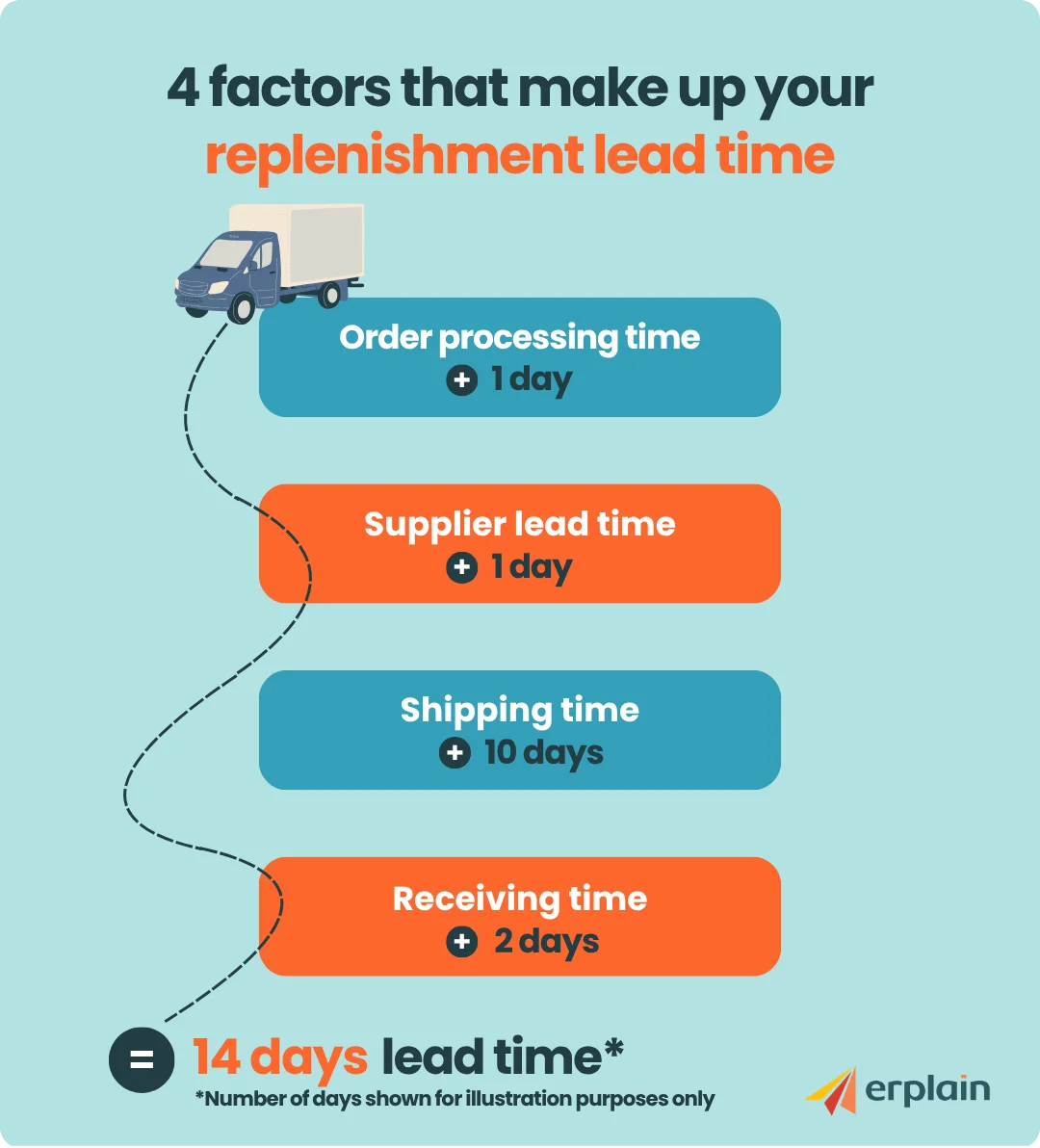
A supplier who says delivery takes “about a week” is not providing enough precision to manage very low inventory levels.
Review the actual lead times from your recent purchase orders. If deliveries range anywhere from four to twelve days, your inventory strategy needs to account for that variability.
You can also formalize commitments with certain suppliers through contracts or agreements that specify expected delivery lead times. This provides greater visibility and helps make a JIT or tight flow operation more reliable.
Before lowering the quantities you keep on hand, make sure the inventory shown in your system matches your physical inventory.
With 500 units in stock, an error of five units may barely be noticeable. With eight units left and a customer order for six, the same error could prevent the order from shipping.
Regular stock counts and accurate records of receipts, shipments, and returns become particularly important when operating with lower inventory levels.
Your stockout rate, actual supplier lead times, inventory turnover, and service level can help you determine whether reducing inventory is actually improving your operations.
If your average inventory is decreasing but late orders are increasing significantly, your reorder thresholds may need to be adjusted.
JIT inventory management requires purchasing decisions to be based on up-to-date data. Sales, purchase orders, and inventory levels therefore need to be tracked in the same system.
With Erplain, every purchase order and sales order updates your inventory information. Teams can view available quantities across multiple inventory locations and track outstanding supplier orders that have not yet been received.
Reorder points also allow you to set a replenishment threshold for each product. When an SKU reaches that level, you receive an alert so you can place a new purchase order at the right time.
For a company looking to operate with less inventory, this visibility changes the way purchasing is managed. You no longer have to wait until a shelf is nearly empty to discover that you should have reordered three days earlier.
Erplain helps businesses align purchasing more closely with actual demand while maintaining clear visibility into inventory levels and open orders.

Just-in-Time inventory management and tight flow can help reduce unnecessary inventory, limit the amount of cash tied up in stock, and adjust replenishment more quickly as demand changes.
In return, they require precise processes. Inventory data must be reliable, suppliers need to be consistent, and lead times must be clearly understood.
For a B2B small or midsize business, a gradual approach often works best. Start by testing the JIT method on products with consistent demand, monitor your actual supplier lead times, and adjust your reorder points. You can then extend the approach to other SKUs where tighter inventory flow provides a clear benefit.
Just-in-Time inventory management is a flow management approach that aims to purchase, produce, or move goods as close as possible to the time they are actually needed. It helps businesses maintain lower inventory levels and reduce the amount of time products remain in storage.
Tight flow is a logistics strategy in which goods are received as close as possible to the time when they are needed for production, distribution, or shipment.
The goal is to minimize intermediate inventory and keep products moving through the supply chain with as little storage time as possible.
A push system is primarily based on forecasts. The company produces or orders goods before it knows the exact level of actual demand, which often leads to more inventory being stored in advance.
Tight flow aims to bring replenishment and the movement of goods closer to actual needs, limiting intermediate inventory and storage time throughout the supply chain.
The concepts are closely related. Just-in-Time (JIT) is the broader flow management approach used to align purchasing, production, and replenishment with actual needs.
Tight flow refers more specifically to the operational organization of logistics flows, with goods arriving and moving through the supply chain close to the time they are needed. A tight flow strategy can therefore be considered one way of applying JIT principles to inventory and logistics operations.
The main risks include:
The lower your inventory levels, the more important it becomes to maintain accurate data and closely monitor replenishment.
JIT inventory management can help businesses:
By ordering closer to actual demand, businesses tie up less cash in inventory and reduce the risk of overstocking. They can also adjust replenishment more quickly as demand changes.





.png)